| |
|
| Whoever Adopts AI Agents First Will Lead the Security Industry |
|
|
|
| jacky yang |
Published: :2026/3/22 |
|
|
|
|
|
| |
|
| |
|
|
| The recent wave of excitement around OpenClaw, the so-called “AI Lobster,” has quickly pushed AI agents out of the tech community and into much broader public awareness. This open-source AI agent platform is designed not merely to answer questions, but to connect through a conversational interface with desktop software, cloud services, and a wide range of tools to execute multi-step tasks. The change it is about to bring is making the real-world potential of agentic AI far more concrete to the market. This trend deserves the security industry’s close attention because AI is no longer being used only for Q&A, summarization, and content generation. It is now beginning to help organize data, connect systems, call tools, execute workflows, and move tasks forward. For the security industry, what is truly needed today is the ability to rapidly integrate information, understand the context of an incident, support precise analysis, identify targets, and locate them efficiently. |
| |
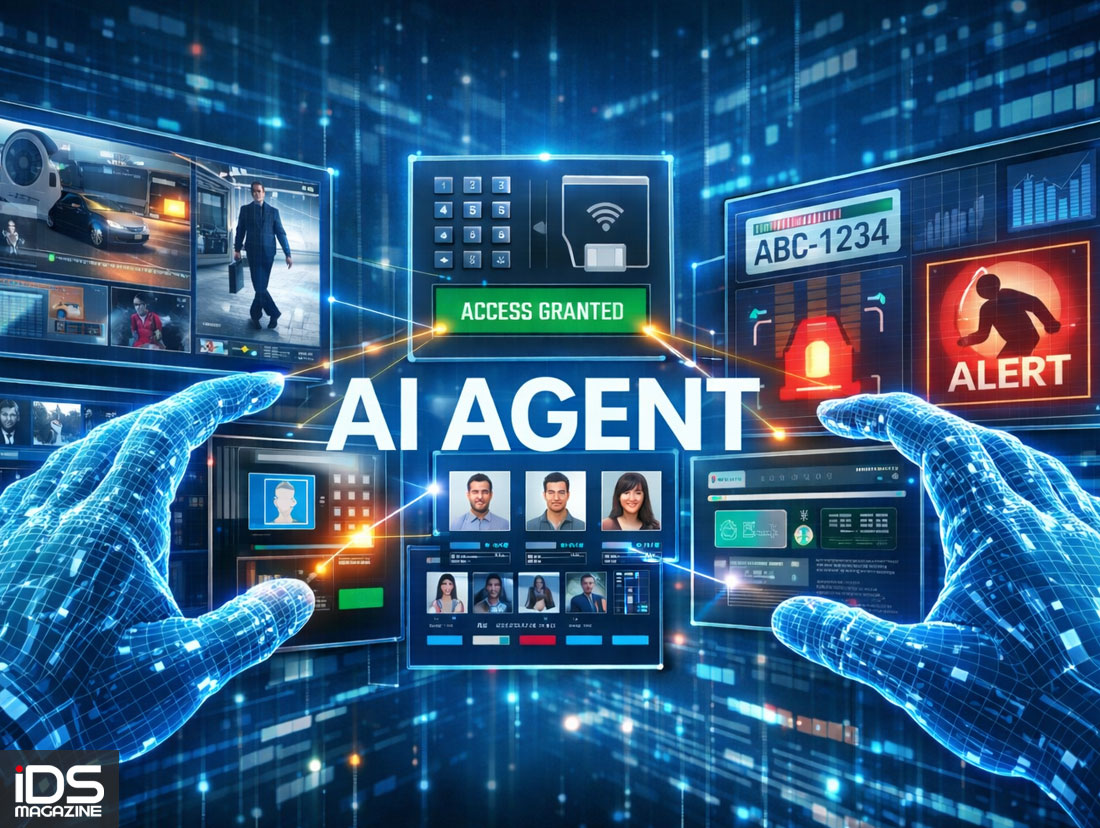
Over the past several years, the security industry’s adoption of AI has focused primarily on the recognition layer. Cameras can detect people, vehicles, smoke, fire, line crossing, and loitering. Platforms can perform license plate recognition, people counting, and abnormal event alerts. Edge devices have also gradually gained stronger inference capabilities. This wave of change has significantly improved the perception capabilities of security systems, allowing them to see incidents faster and moving surveillance from passive recording toward proactive warning. In real-world environments, however, the most time-consuming and labor-intensive part comes after an incident occurs: how managers can quickly extract critical clues from massive amounts of video, access control logs, visitor records, equipment alarms, and multiple disconnected systems, reconstruct the full incident timeline, complete notifications, trigger follow-up actions, and ultimately produce an analysis report.
The Next Step for Security
The simplest way to understand the difference between AI Agents and existing security AI is this: traditional security AI handles recognition, while AI Agents handle tasks. As security devices and platforms continue to accumulate richer metadata, event tags, and open integration capabilities, the foundation is now in place for AI Agents to enter security workflows. Imagine a future in which managers no longer need to sit in front of a control room console 24 hours a day staring at screens. AI Agents will first filter out false alarms, classify which incidents require reporting and which do not, and proactively notify the appropriate personnel when action is needed. On the management side, users will receive periodic analytical reports that may include the attributes, counts, and movement patterns of people and vehicles. They will also be able to use event data generated by front-end devices, object classifications, license plates, human attributes, zone tags, and timeline data to conduct much faster searches, comparisons, and reasoning.
The First Wave Will Begin With Video Retrieval
Among all security applications, the first use case for AI Agents that will be understood and accepted most easily is video retrieval. In the past, when using a VMS to investigate an incident, operators usually had to know the approximate time, location, and likely camera in advance, then manually drag through timelines and review footage segment by segment. If they needed to confirm a person or vehicle, they also had to switch repeatedly between cameras, zoom in on specific areas, and compare before-and-after time periods. The entire process relied heavily on operator experience and patience. Once the number of cameras increases and the size of the site expands, retrieval easily becomes a highly time-consuming and stressful task.
Once AI Agents enter the picture, this way of working will be fundamentally rewritten. In the future, a security supervisor or facility manager will no longer need to instruct staff step by step to “go check whether there was a white delivery truck parked too long near the rear door of Building A between 3:00 and 5:00 yesterday afternoon.” Instead, they will be able to give the system a complete task directly, such as: “Find the white truck that entered the loading area behind Building A yesterday afternoon, stayed longer than five minutes, and then approached the basement entrance. Organize the related video, access control records, and surrounding activities.” After receiving the task, the system will automatically break down the conditions, search relevant data sources, build an incident timeline, and present the results in a format that people can interpret immediately. For large campuses, hospitals, schools, transportation infrastructure, and logistics environments, the structural improvement in investigation efficiency and response speed will be enormous.
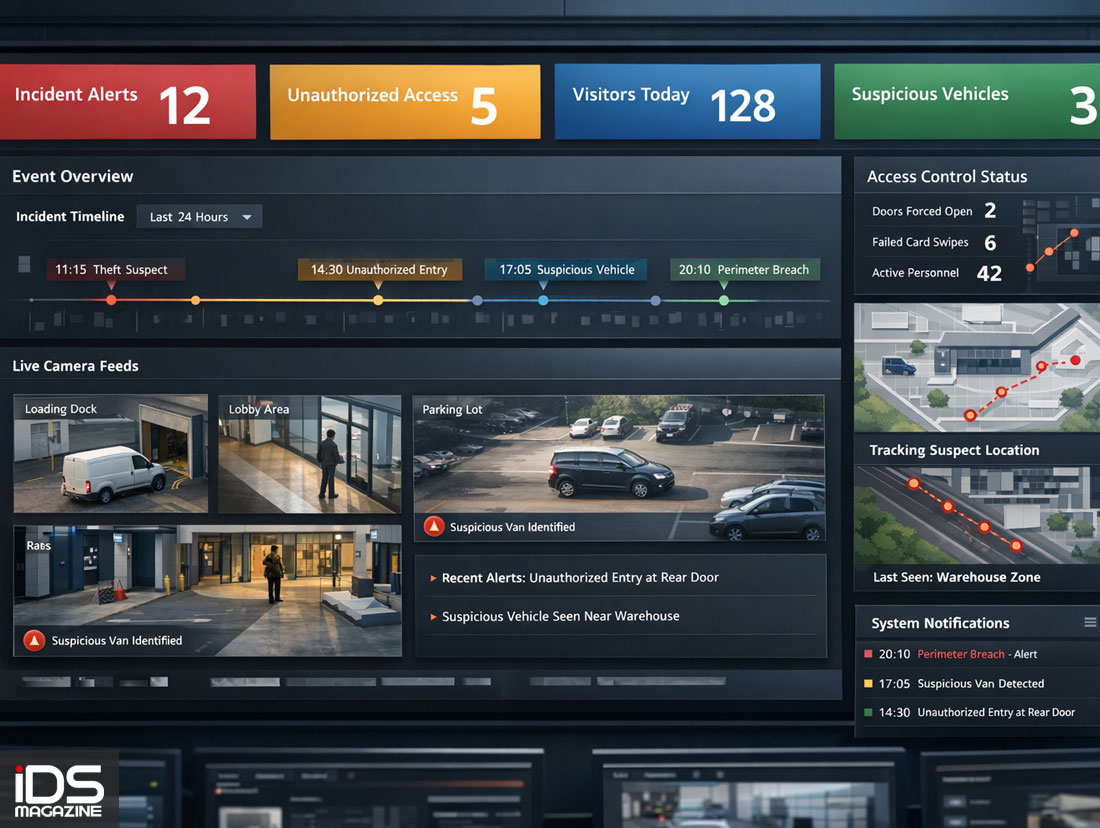
Interfaces Will Shift From Operational Platforms to Decision-Centered Dashboards
Another profound change AI Agents will bring is that the security system interface will no longer be centered on operational control, but instead on management and decision-making through dashboards. In the past, most security platform interfaces were designed around the assumption that people themselves needed to operate the system. Managers had to switch between cameras, set time ranges, manually search video, zoom in on individuals to verify identities, and piece together incident context from multiple windows and different systems. At its core, this kind of interface is an operational tool, and the value of the entire system depends heavily on the user’s experience, familiarity, and judgment.
As AI Agents become involved, the main screen of security platforms will increasingly resemble a dashboard centered on incidents, risks, and key information. When managers log in, the first things they will see are the most important video views, the most relevant data, abnormal event analysis, contextual relationships, and summary conclusions automatically organized by the system. From which high-risk events occurred overnight, to which zones are seeing rising abnormal activity, to which unfamiliar individuals have repeatedly appeared in sensitive areas, to which vehicle has approached a specific entrance multiple times outside normal hours, to what happened before and after an incident and who may be related to it, AI Agents will proactively integrate and present all of this. The way security systems are used will shift from manual operation and step-by-step searching to management interfaces where AI helps interpret, filter, prioritize, and summarize.
This sends a very clear signal to the security industry. The old working model of setting time ranges to search footage, zooming in on people to determine whether they are familiar, and then manually deciding whether the matter should be investigated further will increasingly be taken over by AI Agents. What managers will truly need to do is make judgments and decisions based on information the system has already organized. As a result, the value of security platforms will evolve from operational tools into management hubs.
From Alarm Events to Executable Incident Reports
One of the biggest challenges facing most security systems today is not the lack of alarm events, but the fact that there are too many alarm events, the information is fragmented, and the context is incomplete. Video alarms may appear in the VMS, card access records may sit in the access control system, visitor information may be stored in yet another platform, and equipment abnormalities may exist in the BMS or IoT system. When an incident actually occurs, frontline personnel often still have to switch between multiple interfaces and piece together causal relationships and priorities on their own. This way of working means that many events that should be judged quickly end up losing valuable time in the process of finding and organizing information.
The role of an AI Agent is to automate the contextual work that human operators previously had to perform mentally. In the case of a late-night intrusion, for example, the system in the future will not simply display a line-crossing alert. It may simultaneously compare whether nearby access points were opened abnormally, whether adjacent cameras captured loitering or running behavior, whether unauthorized vehicles approached during the same period, and whether similar abnormalities have occurred in that area in recent days. It can then organize all of this into an incident package with chronological order and risk assessment. For managers, this kind of interface is not merely more convenient. It directly elevates the role of the security platform from an event display tool to an incident understanding platform. The system begins to show the ability to organize context, build situational awareness, and support judgment, allowing personnel to focus more on decisions instead of spending their energy stitching together data.
The Impact of AI Agents Will Extend Into Enterprise Management
The impact of AI Agents on the security industry will not stop at video retrieval or event summarization. Once agents can connect to more external systems through APIs and tool-calling capabilities, their role will naturally expand from the control room to the management of the entire site. For corporate headquarters, smart campuses, factories, schools, hospitals, and transportation facilities, security systems in the future will gradually become digital collaboration platforms capable of coordinating data across platforms, supporting workflows, and assisting frontline response.
More specifically, AI Agents are likely to create visible impact in at least four areas. The first is investigative tasks: they can automatically collect video, access control, license plate, sensor, and historical incident data, elevating investigations from simple searching to case preparation built around contextual integration. The second is real-time response: based on incident severity, the system can trigger notifications, push summarized video views, and provide standard response recommendations, shortening on-site reaction time. The third is routine management: this includes organizing patrol reports, analyzing high-risk time periods, compiling abnormal hotspot statistics, and grouping recurring incidents. The fourth is strategic support: through long-term data analysis, the system can identify risk patterns and help site owners rethink camera placement, patrol routes, visitor paths, and site-management processes. The role of the security system will therefore expand from being a tool inside the monitoring center to becoming a management platform embedded throughout the site’s overall operational logic.
Manufacturers and System Integrators Will Take On New Roles
As AI Agents gradually become part of the security workflow, the way the market competes will change as well. In the past, platform vendors competed on hardware specifications, the number of AI features, and recognition accuracy. System integrators competed on network deployment, device integration, project delivery, and training capabilities. These factors will still matter in the future, but the market will increasingly care about whether a platform can be securely called by an agent, whether its data can be quickly understood, whether workflows can be continuously optimized based on site requirements, and whether its interface can truly support management decisions.
For system integrators, their role will rise accordingly. In the future, the SI will not merely be the party that installs cameras, access control, intercoms, and backend platforms. The SI will also be the party defining how AI works within that environment. Different sites have completely different management logic. Campuses focus on nighttime intrusion and perimeter anomalies. Factories focus on safety violations and unauthorized approaches to hazardous areas. Logistics centers focus on vehicle dispatching, traffic flow, loading and unloading, and abnormal dwell times. Schools and hospitals focus on personnel movement, medication flows, access to sensitive areas, and incident handling. These needs will not be solved by any single functional module. Instead, the market will gradually evolve toward a long-term service model in which the platform vendor provides the underlying capabilities, while the SI and end user together define workflows with the AI Agent at the center. The value of future security projects will increasingly come from continuous optimization after deployment, rather than from one-time delivery.
Of course, AI Agents will bring more than efficiency and convenience. When a system can read more video, access control, equipment, and personal data, and can further call tools, trigger workflows, and generate response recommendations, the attack surface and risk profile will expand as well. As a result, the real question security environments will face when deploying AI Agents is what the agent is allowed to see, what it is allowed to call, who authorizes it to act, whether every step is traceable, and which critical actions must still require human confirmation. This involves a full governance design around least privilege, tiered authorization, audit logs, data isolation, the boundary between human and machine collaboration, and review requirements for critical actions. If security wants to deploy agents, it must first learn how to manage the agents themselves. Only when agentic AI is built on a controllable, auditable, and verifiable architecture can it truly become a trusted tool for improving operational efficiency in high-responsibility environments.
It is already possible to foresee that over the next few years, AI Agents will first spread rapidly through co-pilot-style applications such as natural-language video retrieval, video summarization, incident reporting, cross-system investigations, and dashboard-based management interfaces, before gradually extending into semi-automated response and site workflow coordination. What the security industry truly needs to do now is redefine the value of the system itself. The next phase of competition will come down to who can integrate its own AI Agent into its own system first. That shift will reshape industry rankings and determine who ultimately captures the greatest share of value. |
| |
| |
※The text and images in this article may not be reproduced without authorization. For licensing inquiries, please email contact@aimag.tw — [iDS Magazine Statement]※ |
|
|
|
| |
|
| |
|
|
|
| |
|