| |
|
| A First Look at Thailand’s Security Market |
|
|
|
| Emily |
Published: :2026/1/4 |
|
|
|
|
|
| |
|
| |
|
|
| In recent years, Thailand has gradually emerged as one of the most significant markets within Southeast Asia’s security industry. This shift is driven by the sustained advancement of national digital policies, the steady rollout of government projects, and the parallel growth of demand from both industry and urban sectors. Combined with a mature local system integrator ecosystem, Thailand has formed a market environment with clear structure and a well-defined operational rhythm. |
| |
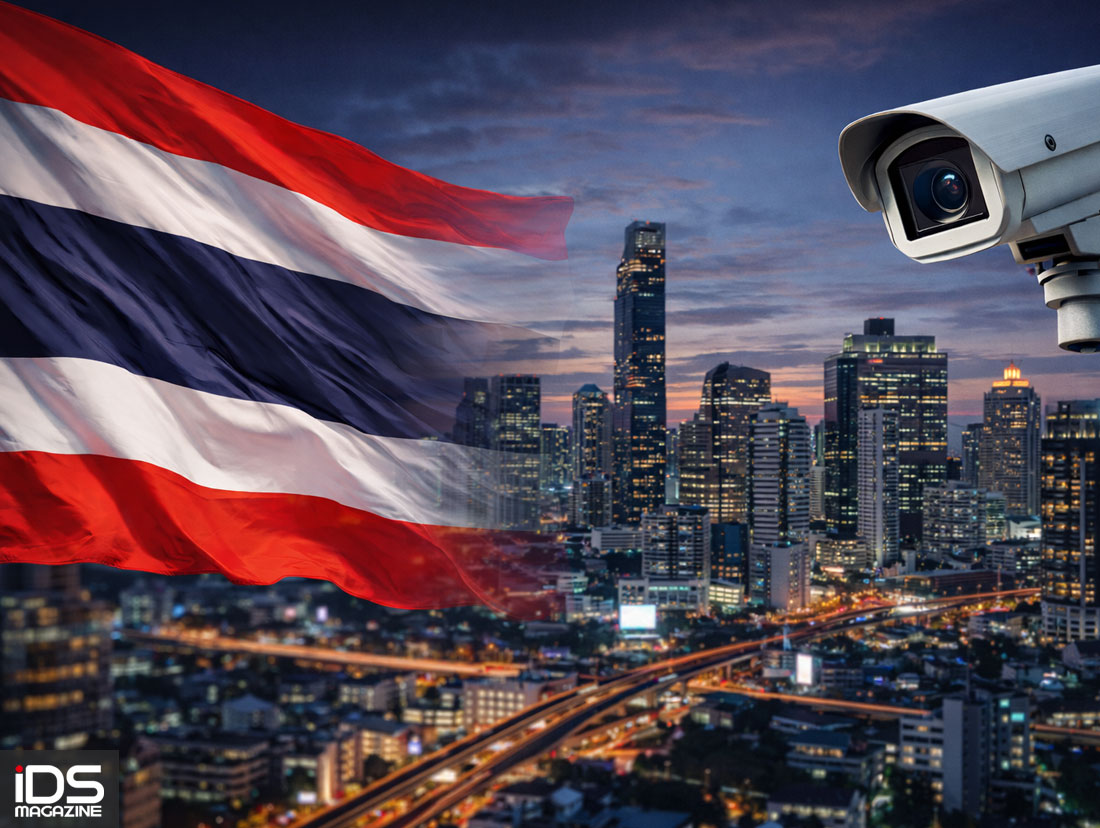
From a market data perspective, Thailand’s CCTV and video security market reached a scale of several hundred million US dollars in 2024 and continues to be driven by smart city initiatives, traffic management, and demand from large commercial facilities. In 2024, Thailand’s CCTV market was estimated at approximately USD 810 million (around THB 26 billion). Over the next decade, it is projected to grow at a compound annual growth rate of roughly 19%, potentially approaching USD 3.9 billion by 2033. This growth momentum is largely fueled by increasing demand from both government and commercial sectors for intelligent surveillance and AI-based sensing capabilities.
The AI CCTV segment alone had already reached an estimated USD 340 million in 2023, with forecasts through 2030 remaining strong. Traffic management and smart city applications continue to act as key drivers. Such rapid growth indicates that local enterprises, international brands, and system integration partners are all actively seeking AI-enabled security solutions that deliver added value rather than basic monitoring functions.
Thailand 4.0 Sets the Pace for Transformation
The structural growth of Thailand’s security demand is closely tied to the country’s overarching national development strategy. Since Thailand 4.0 became the central policy framework, digital governance, smart cities, and industrial upgrading have been positioned as long-term priorities. Video surveillance, AI analytics, and data platforms are increasingly being incorporated into the foundational infrastructure of public governance and urban management.

Under the leadership of the Digital Government Development Agency (DGA), multiple cross-ministerial initiatives have redefined security systems as components of urban sensing and decision-support frameworks. Their role has expanded beyond traditional monitoring to include governance assistance and incident response. Government-led data integration and smart governance architectures promoted by the DGA position video data as a critical node for inter-agency collaboration. From the planning stage, related projects emphasize platform-based design, system integration capability, and long-term operation and maintenance mechanisms. This policy context has directly raised market expectations regarding architectural stability and scalability, while also influencing whether foreign brands can be incorporated into government-led project ecosystems.
At the smart city implementation level, pilot AI video surveillance systems introduced by Bangkok’s traffic authorities have already been applied to detect pedestrian and bicycle violations, integrating directly with enforcement workflows to improve road safety. In 2024, AI-enabled surveillance was deployed across 15 pilot zones to enhance enforcement efficiency and pedestrian protection. Meanwhile, cities such as Phuket, Chiang Mai, and Khon Kaen have in recent years rolled out large-scale CCTV deployments, traffic video analytics, and centralized command platforms. In these projects, the emphasis has shifted toward cross-system integration, real-time analytics, and incident response capabilities, with sheer device count no longer serving as the primary indicator of project effectiveness.
Industrial-Grade Security Demand Driven by the Eastern Economic Corridor
The comprehensive advancement of the Eastern Economic Corridor (EEC) has introduced clearly defined industrial application scenarios into Thailand’s security market. Spanning Chonburi, Rayong, and Chachoengsao provinces, this large-scale economic zone concentrates high-tech manufacturing, smart logistics, ports, and airport facilities. Within this context, security systems have expanded their role to include industrial safety management, logistics coordination, and operational visualization.
Across industrial parks and multinational enterprise sites within the EEC, integrated security architectures are widely adopted for access control, facility patrols, occupational safety monitoring, and traffic management, with growing integration into both OT and IT systems. These environments impose clear requirements on system stability, customization, and long-term maintenance, reinforcing the role of local system integrators as indispensable stakeholders within project execution.

Local System Integrators as Market Gatekeepers
Any serious assessment of Thailand’s security market must acknowledge the decisive influence of major local system integrators. The market has long been shaped by a group of companies with strong capabilities in ICT, security, and smart city integration. These firms routinely handle government, transportation, infrastructure, and large enterprise projects, effectively determining technology adoption paths and market pace.
MFEC is a representative example. The company has long participated in digital transformation initiatives, data center deployments, and urban platform projects for government and major enterprises. In MFEC’s project model, security and video systems are typically embedded within broader ICT architectures rather than treated as standalone deployments. As a result, platform compatibility, API capabilities, and cybersecurity frameworks often outweigh individual device specifications in importance.
Samart Corporation has similarly built deep roots across telecommunications, transportation, and public safety sectors, participating in numerous traffic and public infrastructure projects. Its security deployments are highly integrated with communications systems, command platforms, and backend management environments, with particularly stringent requirements for reliability and long-term operational continuity.
Another notable integrator is G-Able, which has supported government agencies and large enterprises in building digital platforms, data systems, and smart applications for many years. In such projects, security and video systems typically function as data sources that are co-developed with enterprise operations and management platforms. This project model makes long-term integration capability and evolutionary compatibility key thresholds for brand collaboration.
Alongside these large ICT-oriented integrators, a group of security-specialized system integrators has accumulated extensive experience in CCTV, access control, perimeter protection, command centers, and public safety engineering. These firms play significant roles in government facilities, transportation infrastructure, airports, ports, energy installations, and large building projects. In practical implementation and long-term maintenance phases, many transportation, government, and large-scale security systems are effectively inseparable from their involvement.
Loxley Public Company Limited is a prominent example, having long undertaken communications and security engineering projects for government agencies and state-owned enterprises, covering CCTV, public safety systems, and large-scale low-voltage integrations. In Thailand, Loxley is widely regarded as a legacy integrator capable of meeting high-reliability requirements while assuming long-term operational responsibilities, positioning it closer to public safety and infrastructure contracting frameworks. In addition, integrators such as CCTV Thailand and Smart Business Solution have built long-standing track records in video surveillance design, equipment deployment, and system installation, serving commercial, community, and mid-sized projects with proven integration and maintenance capabilities. Their presence underscores the diversity of Thailand’s local integration ecosystem and its capacity to support both large and medium-scale security deployments.
Manufacturer Engagement Shapes SI Willingness to Collaborate
When issues arise on site, system integrators bear the immediate pressure. In practice, clients question the SI first—not the manufacturer—when problems occur. As a result, SIs are highly sensitive to whether manufacturers are willing to stand alongside them on site to resolve issues. Manufacturer responsiveness, willingness to provide hands-on support, and commitment to problem-solving directly influence future collaboration decisions. Over time, this dynamic has formed a clear market filtering mechanism.
Manufacturers that invest in training, provide engineering support, adapt features to project requirements, and maintain continuous product updates are far more likely to be included in long-term partner lists. In contrast, brands that rely solely on distributors, lack on-site support, and offer limited technical engagement often fade from the market after one or two projects. This culture has given Thailand’s security market a distinctive character: partnerships may develop slowly, but once established, they tend to be highly stable. For Taiwanese vendors, this presents an opportunity, as Taiwanese companies often demonstrate greater flexibility in customization, engineering collaboration, and long-term technical support compared with hardware-centric brands.
It is also worth noting that Thai remains the primary language for government documentation, tender specifications, and on-site communication. English is typically reserved for internal communication within multinational enterprises and large system integrators. The ability to provide Thai-language user interfaces, technical documentation, and local support channels is frequently viewed as a key indicator of a brand’s long-term commitment to the market. For system integrators, such preparation often carries more weight than pricing terms alone.
A Market Led by Major System Integrators
Looking ahead over the next decade, Thailand’s security market structure is unlikely to undergo dramatic change. Government and city-level projects will continue to rely heavily on major local system integrators, as project complexity continues to increase. The integration demands spanning video, AI, communications, cybersecurity, and data governance have already exceeded what any single vendor can deliver independently. Companies such as MFEC, Samart, and G-Able—having long managed government and large enterprise projects—are deeply familiar with procurement processes, compliance requirements, and cross-agency collaboration models. They are therefore positioned to remain central players in smart city, traffic management, and large-scale public safety initiatives. For foreign brands, market entry barriers are unlikely to decrease; success will depend increasingly on the ability to establish stable, trust-based partnerships with these leading system integrators. |
| |
| |
※The text and images in this article may not be reproduced without authorization. For licensing inquiries, please email contact@aimag.tw — [iDS Magazine Statement]※ |
|
|
|
| |
|
| |
|
|
|
| |
|